 An official website of the United States government


 ) or https:// means you've safely connected to the .mil website. Share sensitive information only on official, secure websites.


APPRAISE Lands Publication in New England's Top Medical Journal
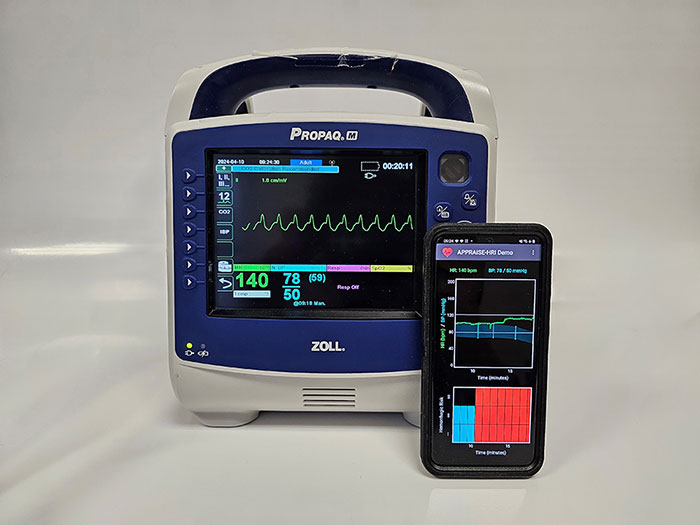
Dr. Jaques Reifman, senior research scientist at the Defense Health Agency Research and Development, published a groundbreaking case report in the November 2025 issue of the prestigious New England Journal of Medicine-Artificial Intelligence. The report highlights his team's FDA-cleared innovation, the Automated Processing of the Physiological Registry for Assessment of Hemorrhage Risk Index which is designed to transform trauma care.
(Photo Credit: Jaques Reifman)
FORT DETRICK, Md. — Getting published in the New England Journal of Medicine-Artificial Intelligence is a rare achievement, with only 5% of submissions accepted annually. Known for featuring groundbreaking medical advancements, this month the journal featured Dr. Jaques Reifman's case report on an AI-driven tool designed to help combat medics save lives by helping triage casualties at the highest risk of dying from a hemorrhage on the battlefield - the Automated Processing of the Physiological Registry for Assessment of Hemorrhage Risk Index.
"It would have been easy to publish anywhere, but what is hard is to publish in the New England Journal of Medicine AI," Reifman said, whose tool was cleared by the FDA. "The reason we were able to push the APPRAISE-HRI through such a prestigious journal speaks to the potential contribution of the work that we do for the Warfighter." Reifman, a senior research scientist for the Defense Health Agency Research and Development, has dedicated his career to advancing technology for military medicine. The inclusion of APPRAISE-HRI in the NEJM AI, having passed both the peer-review and editorial process, is a testament to the tool's potential to improve trauma care for Service Members. "The ability to clearly stratify hemorrhage risk is very valuable, especially in environments where evacuation may be delayed," Reifman explained. "If we have a contested environment and limited ability to evacuate casualties, and if we must keep casualties for long periods of time with limited resources, APPRAISE-HRI allows medics to focus on those at the greatest risk of dying. This ensures that resources are used effectively, and evacuation is prioritized for those who need it most." APPRAISE-HRI was developed and validated using clinical data from diverse environments, including prehospital helicopter transport and emergency departments, to ensure its applicability across different trauma scenarios. Reifman trained the algorithm using 1,700 cases, validated with nearly 6,000 trauma casualties – double the required sample size – demonstrating its reach and reliability. To further enhance credibility, the validation analysis was conducted by an independent statistician from Boston University, who worked with blind data and operated separately from the APPRAISE team. "In fact, the statistician's results exceeded those obtained during the initial training of APPRAISE-HRI, highlighting its robustness when tested in real-world trauma scenarios," said Reifman. "With data collected from nine sites across the United States, the validation demonstrated the system's consistent performance in diverse conditions, further proving its potential to enhance trauma care." The publication of APPRAISE-HRI system in the NEJM AI marks a significant milestone, but its success in real-world applications depends on the trust and confidence of the clinicians and medics who will use it. Building this trust requires users to understand the system's capabilities and limitations, particularly in high-pressure scenarios where effective decision-making is critical. To support this, Reifman's team tailored training programs for combat medics and clinicians to help familiarize users with the system's analytical tools to include vital signs, identify hemorrhage risk, and provide actionable recommendations. Reifman's case report underscores the potential of AI to revolutionize trauma care while setting a new standard for rigorous validation and regulatory alignment. APPRAISE-HRI directly addresses critical challenges in battlefield medicine, equipping combat medics with a reliable tool to prioritize care and evacuation in life-threatening situations. Its inclusion in NEJM AI not only validates the system's scientific foundation but also amplifies its visibility, paving the way for broader adoption and integration into clinical practice. "Our ultimate goal is to empower the Warfighter with technology that not only saves lives but also instills confidence in critical moments. APPRAISE-HRI is designed to be a trusted ally in the most challenging environments, ensuring that medics have the tools they need to make informed decisions when it matters most," Reifman said.