 An official website of the United States government


 ) or https:// means you've safely connected to the .mil website. Share sensitive information only on official, secure websites.

USAMMDA Discontinuation Ceremony Honors 41 Years of Developing and Delivering Medical Capabilities
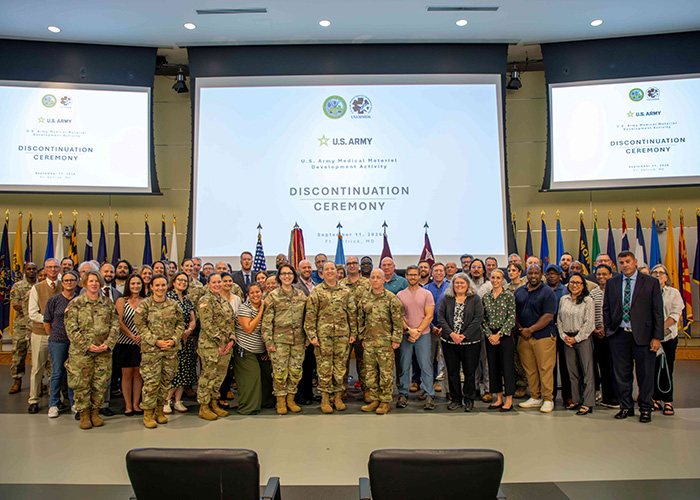
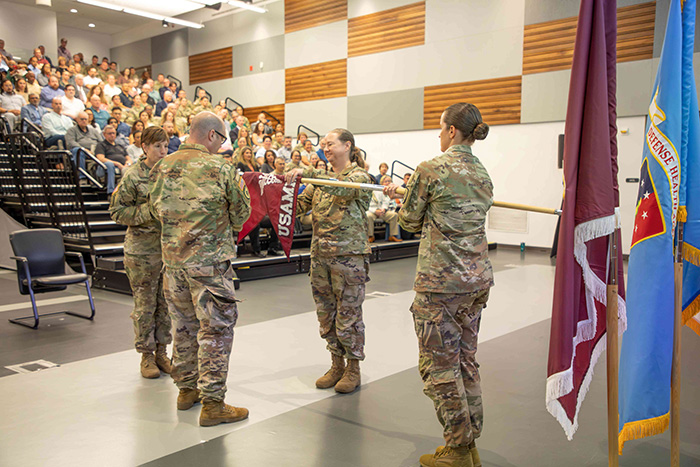
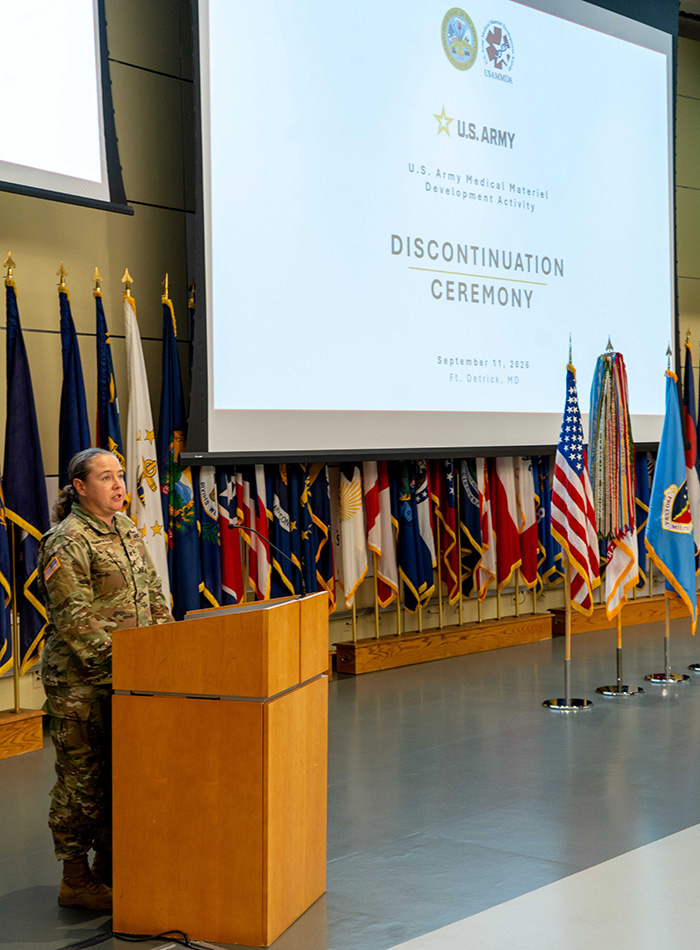
FORT DETRICK, Md. — The U.S. Army Medical Materiel Development Activity (USAMMDA) cased its guidon Sept. 11, 2026, during a discontinuation ceremony at the Fort Detrick Auditorium, marking the end of the organization's service as a command and honoring 41 years of medical innovation, acquisition expertise and support to the warfighter.
The ceremony formally recognized USAMMDA's discontinuation while underscoring that its mission set and workforce continue through successor organizations in the Army and the Defense Health Agency (DHA).
Brig. Gen. Constance L. Jenkins, commanding general of the U.S. Army Medical Research and Development Command (USAMRDC), director of DHA Research and Development, Fort Detrick Senior Mission Commander, and the ceremony's presiding officer, described the occasion as both a major organizational milestone and a continuation of USAMMDA's mission.
"This is more than an administrative action," Jenkins said. "It is one step in a wider transformation of our medical research, development and acquisition enterprise — a transformation that preserves USAMMDA's mission and strengthens its future impact."
For more than four decades, USAMMDA moved medical science from research and development into practical, fielded capabilities for Soldiers and the Joint Force. Its portfolio included medical countermeasures, trauma-care systems, deployable medical equipment, pharmaceuticals, diagnostics, blood products, vaccines, casualty evacuation and medical information systems.
Col. Mara Kreishman-Deitrick, commander of USAMMDA, reflected on the command's history of adapting to evolving missions, operational requirements and acquisition structures.
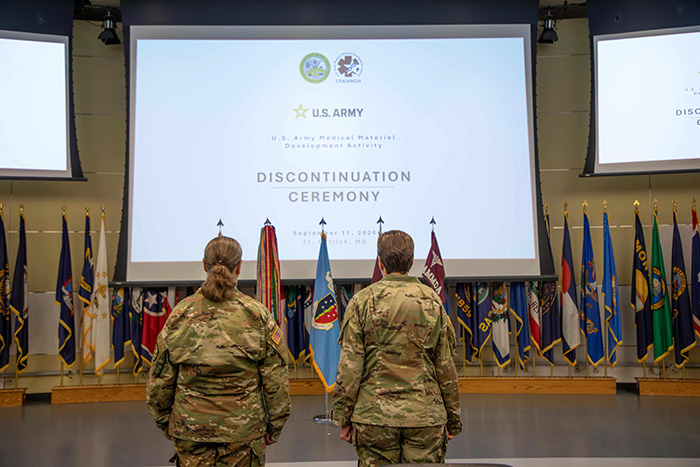
"Through all this change, one thing remained constant: medical capability had to be delivered to the warfighter," Kreishman-Deitrick said. "USAMMDA has never wavered from that mission."
USAMMDA's early work helped establish the foundation for modern battlefield survivability. The organization supported medical countermeasures against chemical and biological threats, specialized surgical equipment, casualty litter systems and preventive vaccines for deploying forces.
As the Global War on Terror reshaped battlefield medicine, USAMMDA fielded capabilities that addressed the immediate needs of deployed formations. The organization delivered armored ambulances and casualty-evacuation platforms, expanded individual trauma care through the Improved First Aid Kit (IFAK), advanced freeze-dried plasma for austere environments and supported next-generation anthrax vaccines.
USAMMDA also modernized point-of-injury and en route care through digital innovation. The command developed and fielded the Transport Telemedicine Systems Medical Hands-free Unified Broadcast system, or TTS MEDHUB, improving casualty tracking and access to patient information during medical evacuation.
During the coronavirus disease 2019 (COVID-19) pandemic, USAMMDA surged ventilators and intensive-care treatment sets, supported medical isolation capabilities and adapted virtual patient wards. The organization later secured and distributed medical countermeasures during the mpox response and continued to advance diagnostics and treatments for infectious diseases, severe malaria, traumatic brain injury and other operational medical challenges.
Jenkins said the organization's legacy extends beyond its products and programs.
"The true measure of USAMMDA is not found in a catalog of equipment," Jenkins said. "It is found in the generations of professionals who dedicated their careers to protecting our force."
The ceremony recognized former USAMMDA commanders in attendance: Col. (Ret.) Jerry Pierson, Col. (Ret.) Stephen Dalal, Col. (Ret.) Russell Coleman, Col. Gina Adam and Col. Andy Nuce.
Distinguished visitors included Rear Adm. Ivonne Arena, acting Assistant Director for Research, Development and Acquisition and Component Acquisition Executive for DHA, and Mr. Andrew Clements, Civilian Executive Director for the Army's Portfolio Acquisition Executive Maneuver Ground (PAE Maneuver Ground).
Kreishman-Deitrick also recognized the Soldiers, civilians, contractors, partners and staff organizations that supported USAMMDA's transition to its new Army and DHA organizations, including personnel from USAMMDA, USAMRDC, PAE Maneuver Ground, DHA and the U.S. Army Transformation and Training Command (T2COM).
USAMMDA's deployable medical equipment, devices and infrastructure programs continue within the Army through Project Manager Maneuver Medical Systems (PM M2S), aligned under PAE Maneuver Ground. PM M2S will continue supporting medical capability and data flows from point of injury through Roles of Care 1 through 3, as well as the Army's Holistic Health and Fitness (H2F) program.
Other USAMMDA programs, including advanced pharmaceuticals, biologics, diagnostics, blood products, expeditionary medical treatment capabilities and brain-health programs, continue through DHA's Portfolio Acquisition Executive–Medical Products (PAE-MP).
"These new organizations are built on USAMMDA's legacy," Kreishman-Deitrick said. "Our recent wins are the culmination of work that started at USAMMDA."
Kreishman-Deitrick said the successor organizations will carry forward the experience and lessons developed throughout USAMMDA's history. "We're not successful now because we've finally landed in the right places," Kreishman-Deitrick said. "We're successful because we're bringing 41 years of experience and the many lessons we've learned as USAMMDA into the new and transforming Department of War acquisition landscape.
Kreishman-Deitrick concluded her remarks with a final recognition of the USAMMDA workforce. "Team USAMMDA, let's show them how it's done," Kreishman-Deitrick said.