 An official website of the United States government


 ) or https:// means you've safely connected to the .mil website. Share sensitive information only on official, secure websites.


From Research to Readiness: A Decade of Science Collaboration Shapes Blast Injury Protection for Warfighters
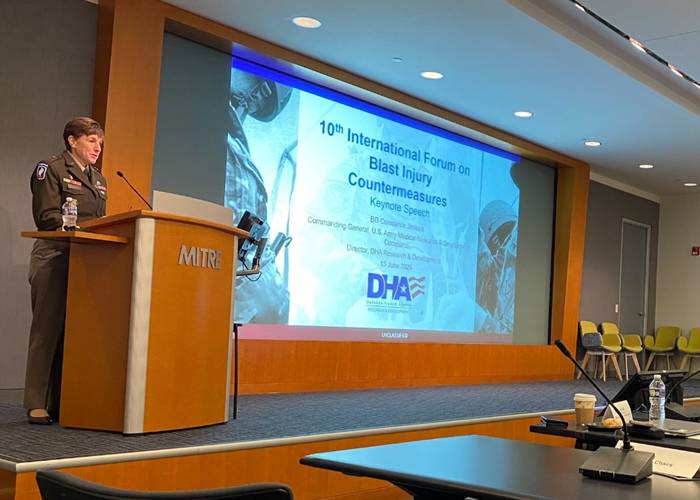
TYSONS CORNER, Va. — In the largest gathering of its 10-year history, over 150 experts representing 11 nations gathered in Tysons Corner, Virginia for the International Forum on Blast Injury Countermeasures hosted by Defense Health Agency Research & Development-Medical Research & Development Command's Blast Injury Research Coordinating Office. Their goal: to safeguard Warfighter brain health and readiness by advancing blast injury prevention, mitigation, and treatment while fostering critical scientific and international collaborations.
Exposure to blast, whether a singular high-level event from incoming munitions or repeated exposure to low-level blasts during heavy weapons training, represents a significant occupational risk not only for military Servicemembers but to the general population as well. In the age of terrorism, explosive attacks are no longer confined to conflict zones. And because Soldiers train as they fight, the danger of blast overpressure (BOP) continues, even in peacetime.
“Historically, we concentrated on acute blast exposure. Today, we recognize the risks posed by repeated low-level blast exposures as well,” said BG Constance Jenkins, Commanding General of the DHA R&D-MRDC, Executive Agent for Medical Research for Prevention, Mitigation and Treatment of Blast injuries and host of the forum. “Blast injury has become the signature threat of the modern battlefield.”
The effects of repeat exposure to low-level blasts are complex and often pose an invisible threat. That is because BOP can affect the body at the cellular level, can impair multiple organs at once, and often manifests as a multitude of symptoms, each of which can compromise personnel safety and operational effectiveness. Symptoms include, but are not limited to, headache, decreased reaction time, attention difficulty, memory loss, poor sleep, impaired vision, impaired hearing, and even digestive problems.
“Because blast injury research is highly complex, no single nation or scientific discipline can address it alone,” said Dr. Raj Gupta, Deputy Director and Senior Science Advisor for BIRCO. “By leveraging the collective expertise of the international community to share information and learn from one another, we can accelerate our understanding of blast injury mechanisms and rapidly transition research into effective clinical and operational countermeasures.”
And that is precisely what IFBIC has achieved. Although it began as a technical information exchange between the U.S. and Japan, the IFBIC forum steadily grew to include representatives from allied nations in Australia, Canada, Germany, South Korea, and the United Kingdom. Each brought unique perspectives from different weapon systems, protective equipment, and areas of expertise. Some even brought insights on future challenges gleaned from the battlefield.
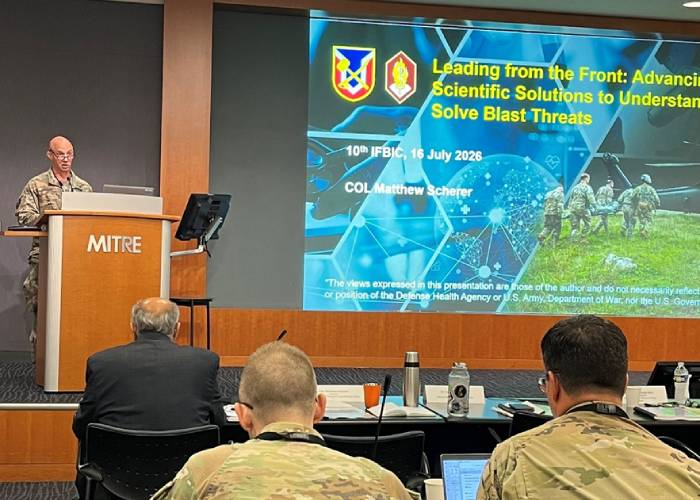
“War is a research accelerant; in this case we must identify and deliver solutions critical to enhancing survivability and sustained lethality. There is much we can learn from the hard-won lessons learned of our Allies and partners on how they are countering blast effects as the character of warfare continues to change and novel delivery systems pose a growing threat,” said COL Matthew Scherer, Director of BIRCO. The first day of the forum included a presentation on the evolving threat of blast injury in modern warfare from Israel. What they are learning was summed up by LTC Steffan Grobert from the German Federal Armed Forces. “Not all blasts are the same. Personal protective equipment that is effective in one environment is not in another. And equipment intended to protect the ears, also seems to protect the eyes.”
This year's forum marked a critical juncture where a decade of foundational blast injury science is now directly informing actionable policy and driving the development of innovative R&D solutions. In a critical effort to translate clinical best practices referencing available evidence, the Department of War Traumatic Brain Injury Center of Excellence published a Blast Overpressure Provider Support Tool with guidance for how medical providers can address low-level blast exposure, as well as a Servicemember Fact Sheet. And the North Atlantic Treaty Organization Science & Technology Organization Human Factors and Medicine panel published HFM-338, a report with guidelines to mitigate military occupational health risks from repetitive blast exposure. The report defines exposure thresholds and frameworks for national blast exposure mitigation programs, directly impacting Warfighter readiness and long-term health.
In a keynote address on the opening day of the forum, Dr. Robin Bowman, Acting Deputy Assistant Secretary of War for Safety and Occupational Health in the Office of the Under Secretary of War for Personnel and Readiness, walked the participants through the Blast Overpressure Research Strategy and Action Plan that began with the fiscal year 2018 National Defense Authorization Act. This plan outlines the evidence-based actions and guidance that have resulted as scientific understanding of the cause and effects of blast overpressure has continued to evolve.
Early summary guidance on mitigating the impact of blast overpressure came in 2022, following a report to Congress with results from a longitudinal medical study on the topic. In response, a memo was issued stating, “to successfully defend our nation, we must optimize physical and cognitive performance to enhance and maintain force readiness” and recognized “the need to synchronize and prioritize efforts into a single and unifying brain health approach to produce more efficient and effective results.” This led to the launch of the Warfighter Brain Health Initiative, a joint effort between the operational and medical communities. Early guidance established interim BOP exposure safety guidelines, identified key weapons systems contributing to BOP, and outlined initial risk management actions for Servicemembers. This guidance also laid out a roadmap of research priorities and completion timelines, underscoring the need for continued scientific inquiry to refine and expand these protective measures.
This foundational work, significantly informed by the collaborative research presented at IFBIC, continues to evolve.
Today, DHA R&D-MRDC, through BIRCO, is at the forefront of translating these insights into tangible, forward-looking solutions that directly support the Department of War's Warfighter Brain Health Initiative and meet the stringent requirements of the fiscal year 2025 National Defense Authorization Act. The FY25 NDAA mandates setting blast exposure safety limits, tracking repetitive low-level blast overpressure, and accelerating baseline neurocognitive assessments for high-risk personnel, underscoring the urgent need for DHA R&D-MRDC's innovative research and development.
DHA R&D-MRDC's research and development efforts are focused on delivering objective tools and materiel solutions that empower leaders and medical personnel to make informed decisions in complex operational environments. These efforts are driven by the understanding that "research creates value only when reflected in training, equipment, and policy," a principle highlighted by IFBIC co-host Lt. Gen. Tomohisa Mori, Vice President of Japan's National Defense Medical College. Key areas of advancement include:
- Advancing low level blast characterization in the garrison training environment in advance of blast sensor fielding to identify potential performance and health limiting effects across multiple vulnerable human systems including cognition, ocular motor function, hearing, and balance.
- Objective Biomarkers for Risk Assessment: Scientists are developing blood-borne protein biomarkers that can objectively identify and quantify blast exposure, particularly for repetitive sub-concussive events. This research is paving the way for tools like the Risk Stratification Algorithm to Identify No-Go/Go system, which will provide commanders with data-driven insights to assess a Servicemember's risk/benefit ratio for deployment or training, moving beyond subjective assessments. Click here to view an article about biomarkers for detection of blast-related brain injuries
- Advanced Computational Modeling and AI Decision Support: Leveraging sophisticated computational models and artificial intelligence, DHA R&D-MRDC is developing predictive capabilities that can simulate blast phenomena and their impact on the human body with increasing detail. These models will inform the design of safer equipment and tactics, and ultimately provide leaders with rapid, scenario-specific guidance for mitigating blast risks in real-time. Click here to view an article about AI use for blast injury decision support
- Enhanced Materiel Solutions and Protective Equipment: Research continues to refine and evaluate PPE against the full spectrum of blast effects. This includes not only improving existing gear but also assessing weapon systems and explosive devices to minimize blast impact on operators. The goal is to engineer safety directly into the tools and equipment Warfighters use, ensuring optimal protection without compromising operational effectiveness.
The 10th IFBIC underscored that the challenge of blast injury is multifaceted, requiring a sustained, collaborative, and innovation-driven approach. DHA R&D-MRDC remains committed to coordinating efforts across a diverse community of medical and non-medical researchers within the DoW, other Federal agencies, academia, the private sector, and international communities. By continuously closing knowledge gaps and translating cutting-edge science into actionable materiel, decision-support tools, and mitigation strategies, DHA R&D-MRDC ensures that our Warfighters are not only protected from the invisible threats of blast exposure but are also equipped with the insights needed to maintain peak readiness and lethality for the future fight. This ongoing work will be instrumental in supporting the Department of War's upcoming Warfighter Brain Health Initiative 2.0, further solidifying the commitment to safeguarding the cognitive and physical well-being of our Servicemembers.
As Lt. Gen. Tomohisa Mori, Vice President of Japan's National Defense Medical College and IFBIC co-host, articulated, "The true value of our research lies in its translation into practical capability - countermeasures reflected in training, equipment, and policy. This forum serves as a vital bridge, strengthening our cooperation and broadening participation across research, medicine, and operations, ensuring our collective efforts continue to safeguard Warfighters for the next decade and beyond." With IFBIC 2027 already planned, the journey from research to readiness is ongoing, and IFBIC stands as a testament to the enduring power of international collaboration in safeguarding those who serve.