 An official website of the United States government


 ) or https:// means you've safely connected to the .mil website. Share sensitive information only on official, secure websites.


Joint Forces Collaborate to Advance Battlefield Medicine in Arctic Edge 2026 Exercises
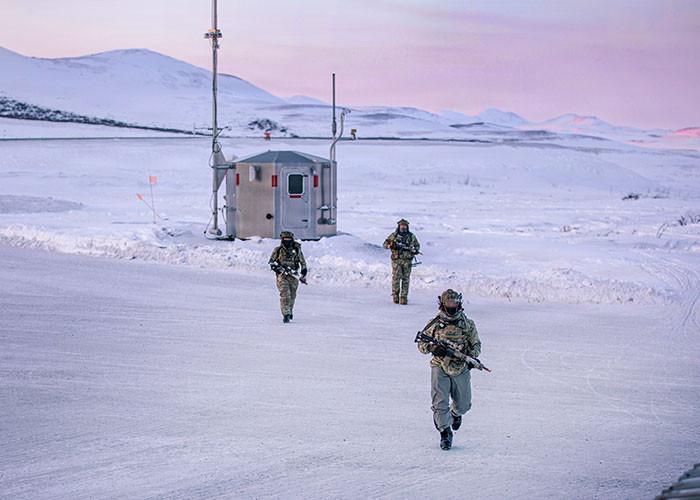
Members of the U.S. Army Medical Research and Development Command (MRDC) recently tested potentially lifesaving tools in Alaska as part of the Arctic Edge 2026 homeland defense exercise.
The team examined how specialized medical innovations -- and those who deploy the technologies – were affected by extreme conditions in the militarily strategic region. Developers are analyzing the data obtained and feedback from frontline end-users to improve the products and move them closer to readiness.
Medical testing was performed as part of the larger land, air, and sea field-training exercise Feb. 23 - March 13, 2026, in Alaska and Greenland and led by the North American Aerospace Defense Command and U.S. Northern Command (NORTHCOM).
The Arctic exercise revealed real-world aspects of the tools and techniques that could not be replicated by exercises conducted in warmer climates, according to Ms. Eva Rosvold, MRDC Experimentation Integration Lead.
"These experiments will definitely help our labs and industry partners to understand the usability and readiness requirements essential to our battlefield medics and providers," Rosvold said.
MRDC underwent rigorous testing at two distinct locations in Alaska, each chosen for its challenging environment and operational relevance. On Kodiak Island, situated along the windswept southern coast, evaluations included ship-to-shore operations, medical evacuation drills, and mass-casualty scenarios, simulating real-world emergencies in harsh maritime conditions. Meanwhile, at Fort Greely in Alaska's remote northern region, the focus shifted to troop-movement scenarios, where the team contended with extreme cold, as temperatures plummeted to 29 degrees below zero. These diverse testing environments ensured the MRDC's capabilities were thoroughly assessed under some of the most demanding conditions imaginable.
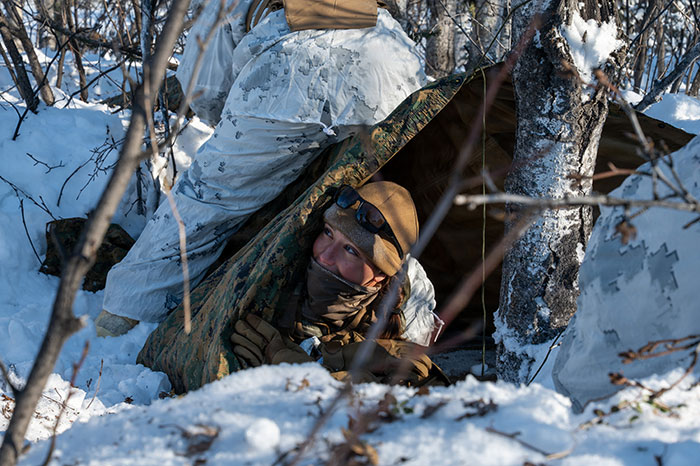
During the Kodiak Island medical scenario, a range of advanced medical technologies were evaluated to address battlefield and traumatic injuries. Among these was a counterflow gauze, designed to rapidly stop severe hemorrhage, and junctional tourniquets, which can control bleeding in areas where traditional tourniquets cannot be applied, such as the groin, shoulder, and under-arm areas. A physiological monitor was also tested, providing real-time data on the health and status of Service Members to enable swift responses to medical emergencies and facilitate care at the point of injury, helping wounded personnel return to duty more quickly. Additionally, the Burn Digital Assessment hand-held tool was used to deliver far-forward assessments of burn severity, offering critical information to guide treatment decisions near the point of wounding. The team also trialed canine freeze-dried plasma, an innovative solution for expeditionary blood replacement, specifically developed for Military Working Dogs assigned to operational units.
At Fort Greely, the experimentation focused on innovations designed to enhance readiness in extreme and hazardous environments. One key technology was a pathogen detection system, deployed during simulated chemical and biological attacks, with both indoor and outdoor testing and lab sampling conducted by teams from the U.S. Army Medical Research Institute of Infectious Diseases (USAMRIID), the Marine Corps Chemical Biological Incident Response Force, the U.S. Naval Research Laboratory, and the Defense Threat Reduction Agency. In addition, the U.S. Army Research Institute for Environmental Medicine (USARIEM) evaluated the usability and nutritional effects of cold-weather Meals Ready to Eat (MREs) with volunteer participants from the Marine Forces Northern Command units (Marine Wing Communications Squadron 48, 4th Marine Aircraft Wing; 3rd Low Altitude Air Defense Battalion, 3rd Marine Aircraft Wing). USARIEM personnel carefully organized, documented, and analyzed participant consumption in the study in an overall effort to ensure Service Members could maintain energy and performance during operations in subzero conditions.
The exercises also tested how well teams worked together, according to Lt. Col. Ryan J. Lindell, Experimentation OIC for MRDC.
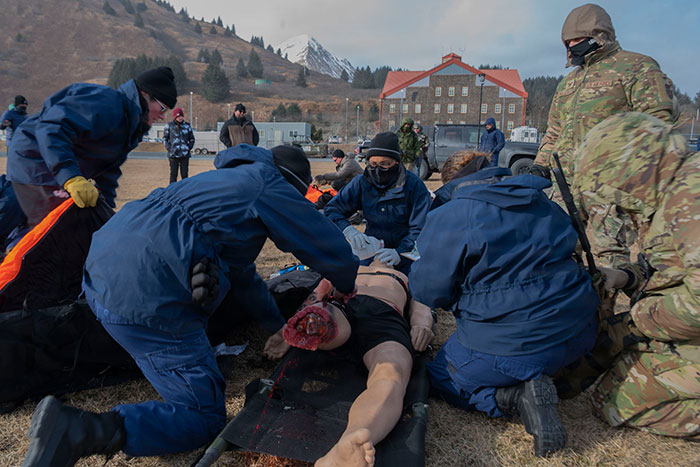
"There was a lot of good news as far as interoperability," Lt. Col. Lindell said. "For example, whether we set up inside with all the lab equipment or set up outside and what processes looks like. Working together ensured we had good quality assurance while also digitally uploading data from afar by the actual boots on the ground personnel."
Throughout the experimentation phase, MRDC actively sought feedback from role-players acting as patients and, most importantly, from frontline, joint-force end users. These included medics and nurses from the 1984th Army Medical Hospital co-located at Fort Wainwright and Joint Base Elmendorf-Richardson (JBER), the Air Force 673rd Medical Group (JBER), as well as the Air Force 673rd Security Forces (JBER), and a two-person mobile Navy En-Route Care System teams responsible for delivering ship-to-shore care to critically injured troops. Navy Expeditionary Resuscitative Surgical System teams also participated, demonstrating their ability to conduct damage control resuscitation and surgery within 10 to 20 minutes in austere forward and maritime environments. Air Force Critical Care Air Transport teams, comprised of four members, showcased their expertise in creating and operating flying intensive-care units. Additionally, the medical team from the U.S. Coast Guard Rockmore-King Clinic in Kodiak contributed valuable insights, ensuring the technologies and procedures were evaluated from a broad spectrum of operational perspectives. Furthermore, the exercise wouldn't have been possible without the collaboration and key involvement with the National Oceanic Atmospheric Administration.
MRDC also worked alongside Naval Medical Research Unit-San Antonio and the Air Force Research Laboratory from Wright-Patterson Air Force Base in Ohio.
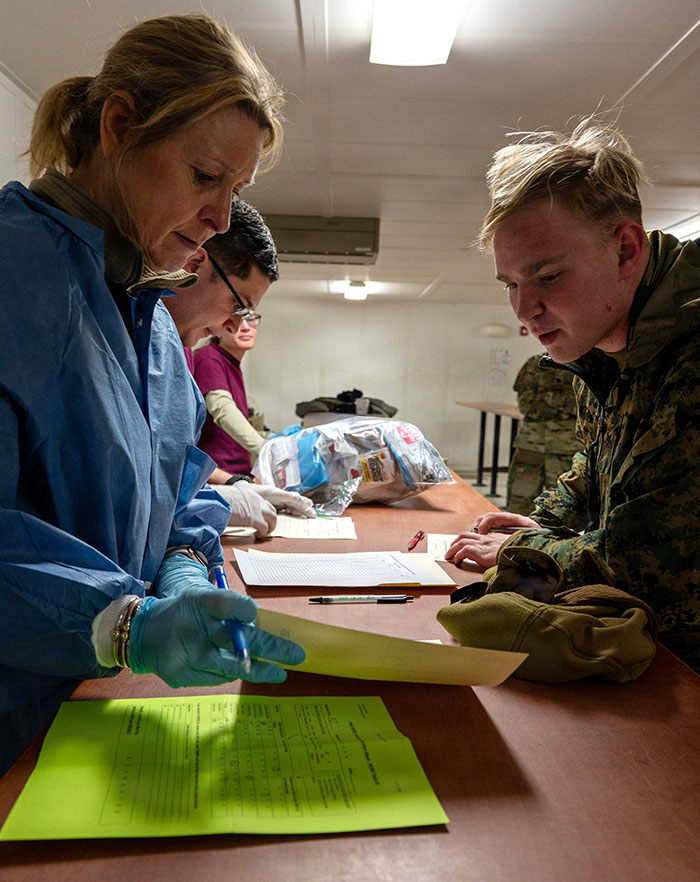
End-users also offered insights on products' packaging, usability, wearability, and training requirements for extreme and austere cold-weather conditions. The freezing temperatures, in addition to putting functionality to the test, revealed practical considerations.
"When [troops] have cold-weather gear they are wearing as a patient or medic and have to take things off in that [extreme cold], the time you have cold-weather gear off is very important -- it has to be very minimal," Rosvold said. "The more industry understands the conditions we work in, the better they can partner with us to help us develop future capabilities."
Development of battlefield medical innovations continues a U.S. military tradition of producing technologies that saves troops' lives.
In the Iraq and Afghanistan wars from 2001-2017, battlefield medics prevented an estimated 3,672 deaths by U.S. forces by using medical practices improved from previous conflicts, according to a study published by the Journal of the American Medical Association. Military trauma system advancements -- namely, improvements in methods to control bleeding, replace blood, and reduce time to treatment -- were associated with 44 percent of mortality reduction.
MRDC's contributions to Arctic Edge 2026 and to effective operations in the extreme conditions of the Arctic region, support operational priorities, as described by Gen. NORTHCOM's Commander, General Gregory M. Guillot, in a statement to Congress.
"Defending North America is inherently linked to the ability of the Joint Force to operate effectively across the entire USNORTHCOM area of responsibility – to include the Arctic," Guillot said. "Arctic responsibilities are shared across multiple geographic and functional combatant commands, and as competition in the region increases, safeguarding Arctic access and freedom of maneuver will depend on [the joint force's] operational capabilities and build on the already strong ties between Arctic partners."