 An official website of the United States government


 ) or https:// means you've safely connected to the .mil website. Share sensitive information only on official, secure websites.



Osseointegration Improves Stability, May Reduce Fall Risk After Limb Loss
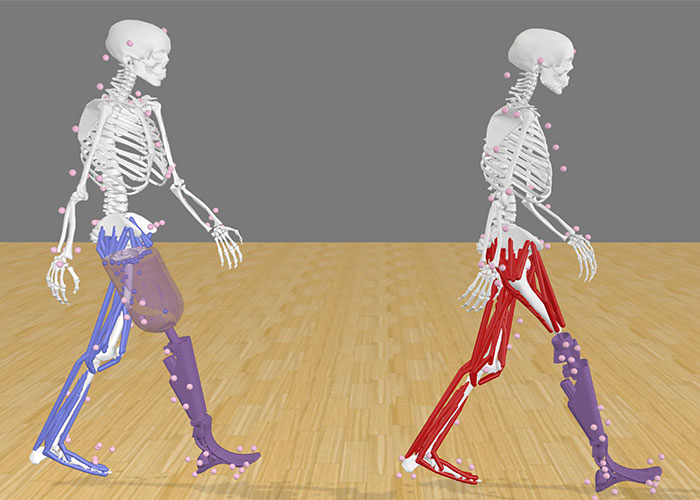
FORT DETRICK, Md. — For many Servicemembers living with limb loss, the challenge is not only learning to walk again but also staying steady on their feet for decades of high-demand activity. Traditional socket prostheses can rub, loosen, and shift in ways that cause discomfort, undermine balance, and increase fall risk. Now, a new study from the Defense Health Agency Research & Development–Medical Research & Development Command's Extremity Trauma & Amputation Center of Excellence provides objective evidence that osseointegration improves walking stability, potentially lowering the risk of falls over the long term. The study supports DHA R&D-MRDC's commitment to modernizing military medicine and sustaining Servicemembers' health and readiness long after injury and into post-service life.
For people with lower-limb amputations, socket-related problems - skin breakdown, pain, poor fit, or changes in limb volume - make it harder to trust each step. Fortunately, osseointegration is a surgical technique that provides patients with a more secure and comfortable experience, allowing for extended wear compared to the traditional socket approach, which in turn reduces skin irritation and enhances awareness of limb position. This is achieved by directly connecting a prosthetic limb to the skeleton using a metal implant, which is placed in the bone and extends through the skin to the external prosthesis.
"Objective measures of stability are critical in assessing fall risk," said Julian Acasio, biomedical research engineer with the Extremity Trauma & Amputation Center of Excellence at the Walter Reed National Military Medical Center. "Osseointegration is an emerging alternative to traditional socket-based prostheses with patient-reported improvements in functional mobility and quality of life. However, there were no objective reports that characterized walking stability following osseointegration, particularly among Servicemembers."
That gap matters in military medicine, where patients are generally younger, more active, and likely to live many decades with their prosthesis. Hence, the EACE team set out to move beyond self-report and measure how osseointegration affects real-world walking stability in Servicemembers who had struggled with socket-based systems. The study, conducted in the Biomechanics and Human Performance Lab at WRNMMC, followed past and present Servicemembers with transfemoral (above-knee) amputation who underwent osseointegration through the Limb Optimization and Osseointegration Program. All participants could walk independently before surgery and at 12- and 24-month follow-up visits. Using motion-capture technology and biomechanical modeling, researchers tracked whole-body movement as participants walked at different speeds and calculated how much "reactive stability demand" their bodies needed to stay balanced during normal, unperturbed walking.
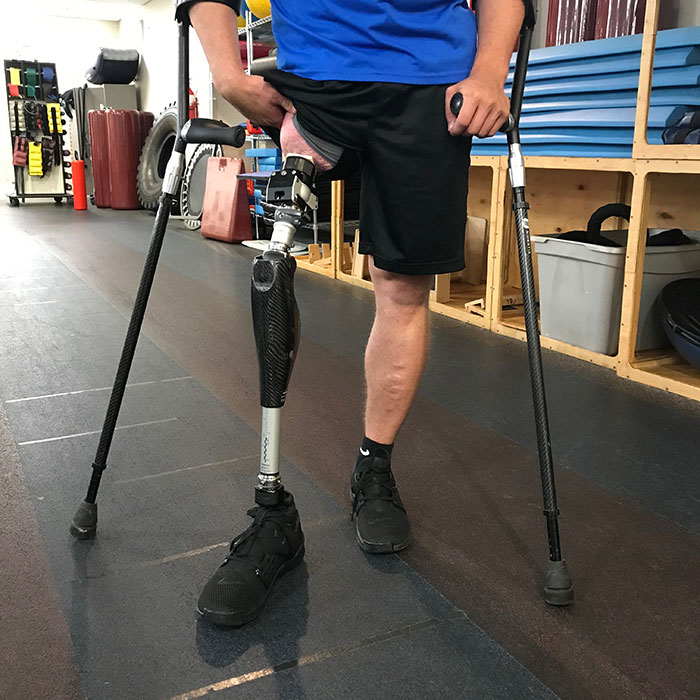
Reactive stability demands describe how hard the body must work to regain balance when something throws it off - even small missteps or the natural, step-to-step variations that occur with every stride. Higher demands mean a person is working harder just to stay upright and may be more vulnerable if something unexpected happens. By measuring these demands, the team could quantify how much hidden work participants' bodies were doing to maintain balance, and how that changed after osseointegration. The main result - reactive stability demands decreased after osseointegration. Participants with osseointegrated prostheses had fewer destabilizing variations in their gait than they did with socket-based devices, and their walking required less reactive effort to maintain balance.
"This suggests that those with osseointegrated versus socket prostheses have fewer destabilizing variations during gait, the human walking cycle, suggesting a more controlled gait and decreased fall risk," explained Acasio.
For clinicians and patients, this provides laboratory-based evidence that supports what many have already reported - that osseointegration can make walking feel steadier and more secure. For Servicemembers and veterans with transfemoral amputation, the stakes are high. They are typically younger at the time of injury than the average civilian, often need high levels of mobility to maintain readiness or return to demanding work, and on average live longer with their prosthesis.
"They are not only living with their amputation longer but are also using their prosthesis much more, making research into optimal human-prosthesis interaction and its long-term ramifications critical," said Acasio.
By suggesting that osseointegration may reduce the effort required to stay balanced during walking, this work supports the advanced surgical approach as a viable alternative for those who cannot achieve a comfortable, stable fit with traditional socket systems. Improved walking stability could translate to fewer falls and injuries, greater confidence on uneven terrain, and better long-term participation in work, family life, and community activities.
Looking ahead, the EACE team plans to study larger groups over longer periods and directly compare outcomes for those using OI versus well-fitted socket prostheses. As this evidence base grows, it will guide clinical decision-making, inform patient counseling, and shape policies on advanced rehabilitation for Servicemembers and other beneficiaries. In the meantime, for Servicemembers with transfemoral amputation, osseointegration may improve gait mechanics and decrease fall risk by providing a more secure connection between limb and prosthesis, resulting in fewer stumbles and a stronger foundation for lifelong mobility.